
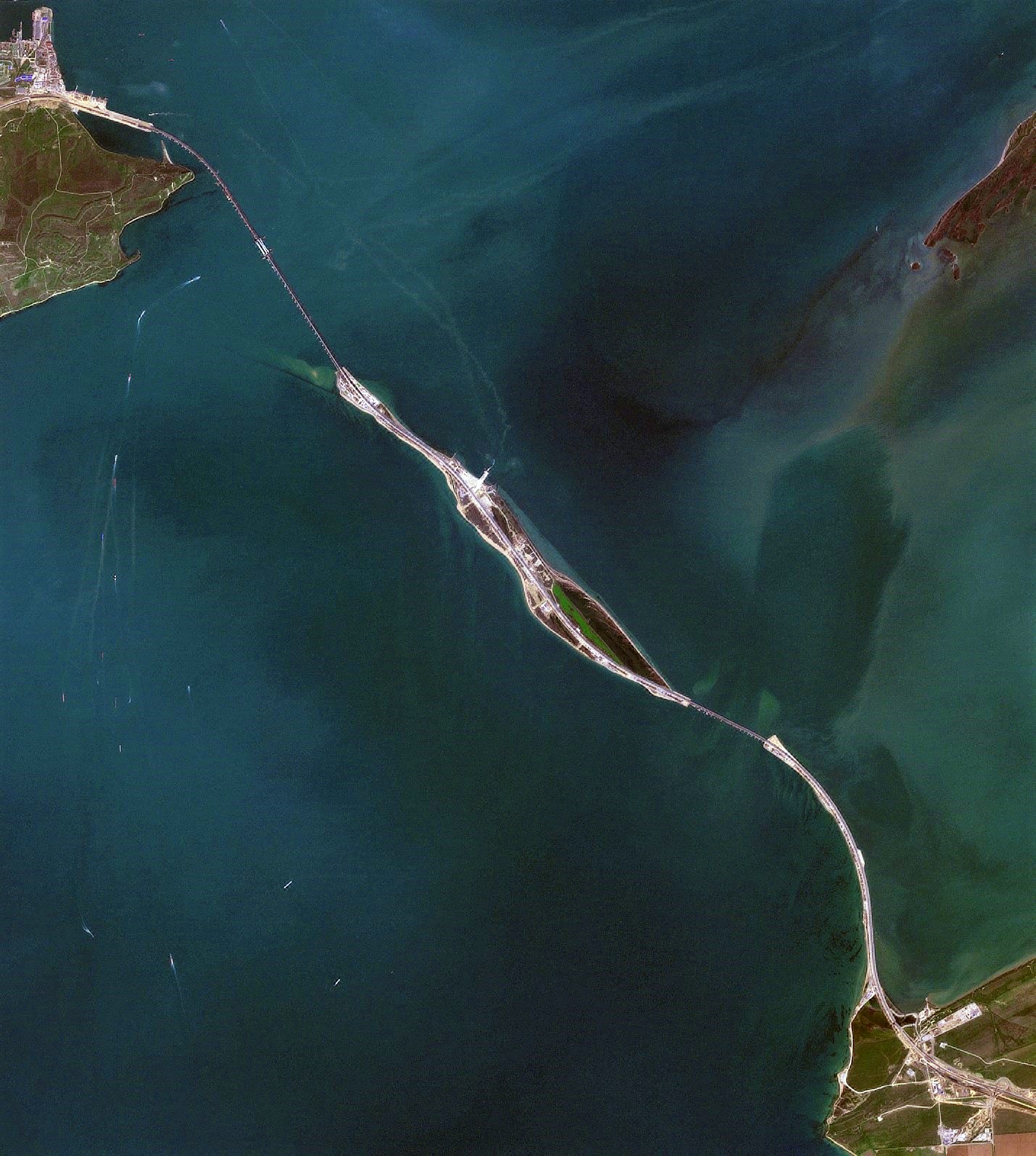
The Crimean Bridge in April 2018 (file photo) — an archive photo, not the damaged bridge. (European Space Agency / Wikimedia Commons, CC BY-SA 3.0 IGO)
Ukraine struck the Crimean Bridge for a second straight day on Tuesday 17 November 2026, in what reports described as the largest Ukrainian drone attack of the war, and unverified video appeared to show the bridge's road arch span collapsed into the Kerch Strait. President Volodymyr Zelenskyy confirmed the attack, calling it retaliation for Russian strikes on Ukrainian infrastructure, including bridges.
The 19-kilometre Kerch Bridge links Russia to occupied Crimea and is one of the most heavily defended structures in the war. Unverified video and photographs that circulated after the strike appeared to show the bridge's entire road arch span collapsed into the water, blocking navigation through the strait. Reuters reported that it could not immediately verify the footage, and there was no official confirmation of the extent of the damage. The Kremlin said the first attack had caused only minor damage.
Crimea's Russian-installed governor, Sergei Aksyonov, said two people were killed in the latest strike, and traffic across the bridge was suspended. The attack marks a sharp escalation in Ukraine's campaign against the bridge, which has been hit before but never, on the available evidence, as heavily as this.
What Zelenskyy Said About the Strike
President Zelenskyy said the strike was the seventh stage of a weeks-long operation run by Ukraine's SBU security service and the General Staff, and he framed it as a direct response to Russian attacks on Ukrainian infrastructure. Russia has been striking Ukrainian bridges, power stations and transport links in recent weeks, and Kyiv's own bridges over the Dnipro were hit on Monday.
Zelenskyy listed the weapons used in the operation: Dovbush, Vendetta, Sichen, MICH 2000, Da Vinci, Palianytsia, An-197, Ruta and FP-1 drones, as well as FP-5 Flamingo and R-360 Neptune cruise missiles. According to the account, Palianytsia drones hit the road section of the bridge, while Neptune missiles and Ruta and FP-5 drones hit the rail section.
The detail in the announcement is unusual and appears designed to show the scale and sophistication of the operation. Whether the bridge's road arch has in fact collapsed will only be clear when verified images emerge, but the suspension of traffic and the reported deaths confirm that the strike caused serious damage.
Russia Pounds Kyiv's Bridges
While Ukraine was striking the Crimean Bridge, Russia was hitting bridges of its own in Kyiv. Mayor Vitali Klitschko said Russia struck the capital's North and South bridges spanning the Dnipro and partially damaged the metro system. Moscow confirmed the strikes.
Russia's defence ministry said it had hit transport, military and energy facilities in Kyiv, Zaporizhzhia, Cherkasy and Dnipropetrovsk, as well as port infrastructure and cargo ships. The strikes on Kyiv's bridges follow the pattern of recent Russian attacks on Ukrainian transport links, and they were the reason Zelenskyy gave for the retaliation against the Crimean Bridge.
The exchange of bridge strikes shows how the war has shifted towards infrastructure. Both sides are now targeting the roads, railways and bridges that move troops and supplies, and each strike invites a response against the other's links. The Crimean Bridge is the most symbolic of those targets: it was built by Russia after the 2014 annexation of Crimea and has been presented by Moscow as a permanent link between Russia and the peninsula.
Why the Crimean Bridge Matters
The Crimean Bridge is the most symbolic target in the war. It was built by Russia after the 2014 annexation of Crimea and has been presented by Moscow as a permanent link between Russia and the peninsula. It is also a practical lifeline: the bridge carries road and rail traffic that supplies Russian forces in Crimea and in occupied southern Ukraine. If the road arch has collapsed, the bridge's road traffic — and possibly its rail traffic — could be out of action for weeks or months, forcing Russia to supply Crimea by sea and by the land corridor through occupied territory.
What Happens Next
The wider question is whether the bridge strikes push the war towards a new phase. Peace talks involving Ukraine, the United States and European countries have been under way, and both sides have been striking infrastructure even as diplomats talk. The Crimean Bridge attack will harden positions in Moscow, where the bridge is a symbol of the annexation, and it will be presented in Kyiv as proof that Ukraine can still hit Russia's most protected targets.
For now, the facts that are confirmed are these: Ukraine struck the bridge for a second day, Zelenskyy confirmed the attack, two people were killed according to the Russian-installed governor, traffic is suspended, and the footage that appears to show the collapsed arch has not been independently verified. The rest — the full extent of the damage and the consequences for the war — will become clear in the days ahead.
Related reading: Iran Hits US Radar in Bahrain, US Strikes Qeshm and Quad Summit in Manila as APEC Opens in Shenzhen. More world news: World News.
FAQ
What happened to the Crimean Bridge on 17 November 2026?
Ukraine struck the 19-km Kerch Bridge for a second straight day. Unverified video appeared to show its road arch collapsed into the Kerch Strait, but Reuters could not immediately verify the footage and there is no official confirmation of the damage.
Who confirmed the strike?
President Volodymyr Zelenskyy confirmed the attack, calling it retaliation for Russian strikes on Ukrainian infrastructure. Crimea's Russian-installed governor Sergei Aksyonov said two people were killed and traffic was suspended.
What did Russia do in Kyiv?
Mayor Vitali Klitschko said Russia struck Kyiv's North and South bridges over the Dnipro and partially damaged the metro system; Moscow confirmed the strikes on transport, military and energy facilities.
Comments
Post a Comment